
It is 2:14 AM on a Tuesday. Your flagship e-commerce storefront or enterprise marketing platform is in the middle of a high-concurrency international campaign. Suddenly, an automated script routine, a delayed server database bottleneck, or an unexpected plugin update failure triggers a catastrophic code regression.
The live site drops offline. Visitors are greeted by a blank screen or a critical system error message.
For most corporate marketing directors, digital agency heads, and business founders, this is the ultimate operational nightmare. You wake up to a flood of urgent system monitoring alerts, flashing error logs, and customer complaints. You frantically message your internal developers, only to find them completely unreachable. You try contacting your standard web hosting support chat, but you are stuck waiting behind an unmanaged queue, speaking to a tier-one support rep reading from a basic generic script.
This is The Improvised Crisis Bottleneck. Attempting to triage severe infrastructure failures, malicious file injections, or payment gateway drops by guessing under extreme pressure is a recipe for operational failure.
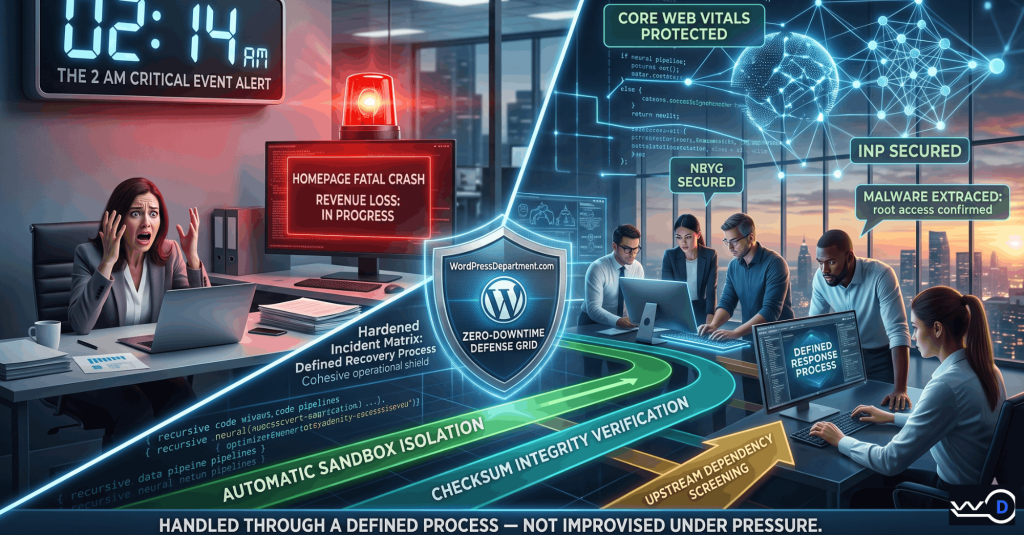
When your revenue engine goes down, you’re not on your own at 2 AM. True digital scaling requires moving away from chaotic middle-of-the-night panic and leaning into an engineered operational shield. At WordPressDepartment.com, hacks, downtime, and broken functionality after updates are handled through a defined process—not improvised from scratch under pressure.
1. Why Improvisation Destroys Digital ROI
When an unmanaged corporate website encounters a major technical issue in the dead of night, the standard human reaction is to patch the visible symptom as fast as possible. But without a structured playbook, this chaotic debugging routinely introduces massive, long-term Technical Debt.
┌────────────────────────────────────────────────────────┐
│             THE PANIC-DRIVEN DEBUGGING LOOP            │
├────────────────────────────────────────────────────────┤
│ 1. HOMEPAGE FATAL CRASH    ► Panic overrides logic     │
│ 2. REACTIVE CONFIG PATCH   ► Overwrites core systems   │
│ 3. CASCADE STYLE COLLISION ► Second-wave platform drop │
└───────────────────────────┬────────────────────────────┘
                            │  Cascading Operational Ruin
                            ▼
┌────────────────────────────────────────────────────────┐
│               UNMANAGED REVENUE LOSS                   │
│ Intercepted Checkouts • Ruined INP • Dropped Rankings  │
└────────────────────────────────────────────────────────┘
When an untrained team improvises a fix under stress, they expose your site to three costly side effects:
A. Untracked Core Overwrites
In a rush to fix a site crash, an engineer might modify your server configuration files or core application paths directly on your live production environment. This temporary fix may get the site back up for an hour, but it routinely conflicts with your next software deployment , triggering a far more severe system freeze later down the road.
B. Missing Deep Backdoor Layers
If your site experiences a malicious file injection, simply restoring a basic backup file or running a surface-level cleaner plugin is insufficient. Automated bot networks hide recursive backend .php fragments deep inside unexpected asset directories. If your team fails to execute a full core validation check, the malicious backdoor stays live on your server, letting hackers exploit your database again a few days later.
C. Broken Layout Shifts & Code Friction
Rushed fixes often bypass basic mobile performance validation checks. This introduces layout shifting and scripts that block your browser's primary processing threads. This code bloat ruins your mobile Interaction to Next Paint (INP) metrics, leading directly to search visibility penalties from Google algorithms.
2. Our Defined Recovery Process
We don’t wait for a crisis to figure out how to solve it. At WordPressDepartment.com/operations, our engineering wing follows a precise, multi-tiered Emergency Incident Framework the second an alert hits our monitoring boards:
Pillar 1: Automatic Sandbox Isolation
We never debug code issues on your live production server. Our team immediately clones your active system layers into a completely isolated staging sandbox environment. This allows us to run extensive forensic troubleshooting without risking further downtime for your public-facing visitors.
Pillar 2: Checksum Integrity Verification
For malware attacks and hack removals , we run cross-verification audits against official cryptographic records from the WordPress core repository. This structural scan detects and flushes out malicious scripts, bad actors, and hidden database entries instantly.
Pillar 3: Upstream Dependency Screening
When third-party plugin updates break your storefront functionality or checkout logic, our process maps the code execution tree to identify the specific file line causing the error. We then deploy a clean server-side component rewrite to safely bypass the broken script.
3. Enforcing Defensive Global Error Handlers
To protect your business transactions from a sudden crash if a third-party tracking pixel or background analytics module goes down mid-execution, your code must use defensive programming.
Below is an enterprise production snippet showing how our developers build exception catching gates directly into system layers, ensuring your site log filters the error safely in the background instead of allowing a script collision to take down your public user interface:
PHP
<?php
/**
 * Corporate Structural Fault Governor
 * Programmatically screens and wraps heavy external integrations inside
 * defensive try-catch loops to protect Core Web Vitals and prevent 2 AM crashes.
 *
 * Engineered for System Sovereignty - WordPressDepartment.com
 */

if ( ! defined( 'ABSPATH' ) ) {
    exit;
}

add_action( 'wp_ajax_execute_secure_checkout_handshake', 'enforce_sovereign_fault_containment' );

function enforce_sovereign_fault_containment() {
    // 1. Validate security nonces to neutralize automated script manipulation loops
    if ( ! isset( $_POST['gateway_token'] ) || ! wp_verify_nonce( $_POST['gateway_token'], 'secure_checkout_nonce' ) ) {
        wp_send_json_error( 'Cryptographic Token Invalidation', 403 );
    }

    // 2. Wrap the high-overhead transaction pathway inside a defensive try-catch matrix
    try {
        // Enforce a strict execution window to prevent your server thread from locking up
        $api_handshake = wp_remote_post( 'https://api.gateway.internal/v2/charge', [
            'timeout'   => 4, // Strict time cap to prevent server lag cascades
            'blocking'  => true,
            'body'      => [ 'transaction_integrity' => 'verified' ]
        ]);

        if ( is_wp_error( $api_handshake ) ) {
            throw new Exception( $api_handshake->get_error_message() );
        }

        wp_send_json_success( 'Transactional Ledger Successfully Synchronized' );

    } catch ( Exception $captured_regression ) {
        /**
         * 3. Record the technical error securely to internal logs.
         * This isolates the error data in the background without throwing a fatal crash
         * or exposing internal code bugs to your public-facing users.
         */
        error_log( '[OPERATIONS INCIDENT DETECT] Critical API Timeout Intercepted: ' . $captured_regression->getMessage() );

        // Gracefully switch to a stable, cached checkout path to protect your sales velocity
        wp_send_json_error( 'Primary Network Latency: Automated Fallback Matrix Triggered', 503 );
    }
}
4. The Financial ROI of Process-Driven Care
Moving away from loose, chaotic troubleshooting and standardizing your platform protection with an engineered operations team turns your site safety into a predictable driver of business growth.
Sustained Search Visibility Protection
Organic search engines use automated crawlers to check your site around the clock. If a crawler encounters a 500 server error multiple times while your site is broken at night, your search rankings will drop. Rapid, process-driven remediation protects your visibility.
Maximized Advertising Budget Efficiency
Eliminating page response lag across your landing experiences ensures that when a user clicks a paid marketing ad, your site loads instantly, preventing bounce rates and lowering your customer acquisition costs.
Absolute Operational Liberation
Trusting your backend engineering to a dedicated team gives your executives peace of mind, knowing your digital storefront is protected by an elite technical squad 24/7/365.
Download the 2026 Enterprise Infrastructure Hardening Protocol
Evaluate your current platform’s vulnerability to SaaS vendor lock-in, map out background code clutter, and learn how to transition to a high-speed sovereign framework.
Frequently Asked Questions
Request a Professional Security Audit
Your digital asset should be an ultra-fast, completely secure conversion pipeline, not an unmanaged environment that risks database lag or middle-of-the-night technical panic. Stop guessing under pressure when code errors strike. Partner with our senior enterprise engineering and platform optimization architects to eliminate legacy technical debt, secure your code pipelines, and protect your brand’s digital growth.
To understand the company behind these solutions, you can explore Staxtar’s official platform for more technical and business details.




