
For enterprise digital directors, mid-market marketing executives, and high-volume e-commerce founders, a catastrophic website crash is actually a twisted kind of blessing.
The harsh reality of modern web systems is that your website doesn’t fail loudly. It fails quietly, then all at once.
1. The Three Hidden Leaks
A website rarely degrades overnight. Instead, it experiences a slow, invisible decline where minor code frictions compound in the background until the entire system hits a breaking point.
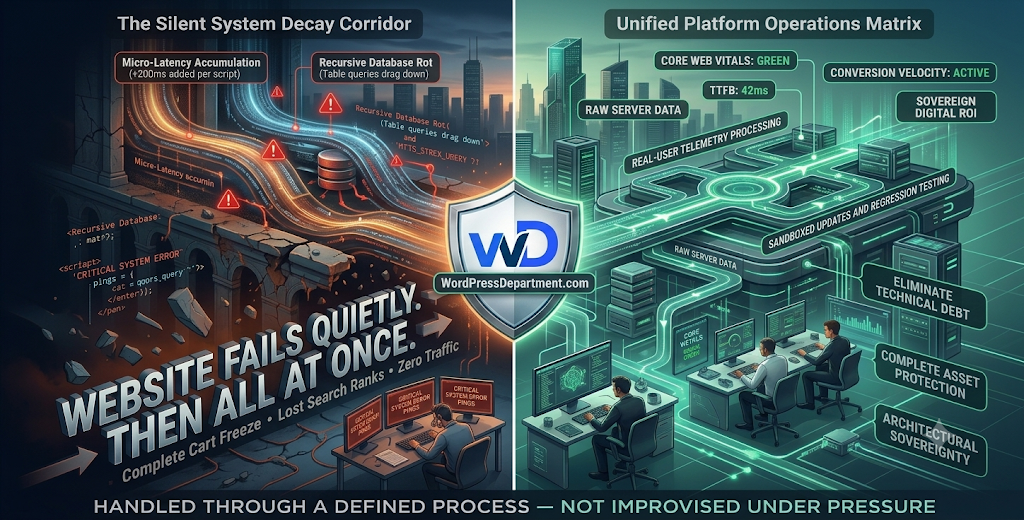
┌────────────────────────────────────────────────────────┐
│             THE SILENT SYSTEM DECAY CORRIDOR           │
├────────────────────────────────────────────────────────┤
│ 1. MICRO-LATENCY ACCUMULATION ► 200ms added per script │
│ 2. RECURSIVE DATABASE ROT     ► Table queries drag down│
│ 3. BOT ALGORITHM DEMOTION    ► Google flags bad INP   │
└───────────────────────────┬────────────────────────────┘
                            │  Compounding System Stress
                            ▼
┌────────────────────────────────────────────────────────┐
│               THE "ALL AT ONCE" COLLAPSE               │
│ Complete Cart Freeze • Lost Search Ranks • Zero Traffic│
└────────────────────────────────────────────────────────┘
When your platform operations are handled reactively, your business routinely falls victim to three silent killers:
A. Micro-Latency Leakage (The Conversion Killer)
Every time your marketing team dumps a new unvetted tracking script, tag manager pixel, or heavy font file onto your site, your page load speed slips. A hundred milliseconds here and there won't show up on a standard desktop uptime checker. But on a real-world mobile network, that micro-latency creates a frustrating lag that quietly causes visitors to abandon their carts before completing a purchase.
B. Recursive Database Bloat (The Invisible Weight)
Every background plugin revision , auto-saved page draft, and expired transient cache writes clutter straight into your MySQL options table. As this table fragments, your database queries take longer and longer to execute. The site works fine under low baseline traffic, but the exact second a marketing push spikes user concurrency, the database tables lock up, freezing your checkout lines.
C. The Crawl-Budget Blacklist (The Algorithmic Drop)
Google's automated indexing bots read your source code long before human eyes see a problem. If your site exhibits background thread blocks or layout shifts due to a messy plugin structure, Google doesn't send you a warning email—it simply, quietly demotes your keyword rankings to protect its searchers from a poor user experience.
2. Proactive Platform Governance
Asynchronous Live Telemetry Tracking
We don't rely on retrospective analytics logs. We monitor your real-world performance indicators, core processing threads, and server-side resource pools in real time to catch micro-latency before it impacts user behavior.
Isolated Sandbox Code Verification
Running updates or configuration shifts directly on a live production server is a major risk. We test every software patch inside an isolated staging sandbox first, running strict automated regressions to ensure your core transaction pathways remain pristine.
Database Optimization & Architectural Hardening
We continuously clean out background database clutter, index core options tables, and deploy edge firewalls to keep your software light, fast, and entirely resilient under pressure.
3. Enforcing Hardened Asynchronous Asset Isolation
To protect your business transactions from a sudden freeze if a third-party script or external API experiences an unexpected delay mid-execution, your code layout must use defensive, asynchronous programming.
Below is a production snippet showing how our engineering team builds error-catching gates into your core functions, ensuring that if a background tracking asset fails or hangs, your site automatically bypasses the bottleneck without locking up your user interface:
PHP
<?php
/**
 * Corporate Structural Latency Governor
 * Programmatically insulates external marketing scripts within defensive,
 * asynchronous check loops to protect mobile Core Web Vitals and prevent crashes.
 *
 * Engineered for Platform Sovereignty - WordPressDepartment.com
 */

if ( ! defined( 'ABSPATH' ) ) {
    exit;
}

add_action( 'wp_footer', 'deploy_asynchronous_latency_shield', 99 );

function deploy_asynchronous_latency_shield() {
    // 1. Permanently bypass telemetry loops within administrative workspaces
    if ( is_admin() ) {
        return;
    }

    /**
     * 2. Wrap External Integrations inside a Non-Blocking Gate
     * We set a strict 2-second timeout cap. If the external marketing vendor's
     * server lags, our system cuts the connection, keeping user paths fast.
     */
    try {
        $external_script_node = 'https://telemetry.external-tracker.internal/v1/log';

        $background_ping = wp_remote_get( $external_script_node, [
            'timeout'   => 2, // Strict execution cap to shield the browser main thread
            'blocking'  => false, // Dispatched completely in the background
            'headers'   => [ 'X-Ops-Context' => 'Sovereign-Shield-Active' ]
        ]);

        if ( is_wp_error( $background_ping ) ) {
            throw new Exception( $background_ping->get_error_message() );
        }

    } catch ( Exception $silent_regression ) {
        /**
         * 3. Record the Error Securely to Background Logs.
         * We catch the delay and document it quietly behind the scenes,
         * ensuring the frontend page continues to load flawlessly for visitors.
         */
        error_log( '[OPERATIONS WARNING] External script latency intercepted safely: ' . $silent_regression->getMessage() );
    }
}
4. Transform Data Clarity into Real Business Growth
Taking full ownership of your code environment and proactively managing technical risks completely changes your business trajectory:
Sustained Global Search Domination
Keeping your technical code pristine means Google's search crawlers can read and index your layout trees cleanly, maximizing your crawl budget and protecting your high-value keyword positions.
Maximized Advertising Budget Efficiency
Eliminating mobile loading delays ensures that when a prospect clicks a paid campaign ad, your page loads instantly, slashing bounce rates and driving down your overall customer acquisition costs.
Absolute Operational Peace of Mind
Entrusting your platform infrastructure to a dedicated engineering group leaves your marketing team completely free to build and scale your brand without worrying about midnight site crashes.
Download the 2026 Website Scalability Blueprint
Evaluate your current platform’s vulnerability to unmanaged code clutter, identify hidden background database bottlenecks, and learn how to transition to a high-speed sovereign framework.
Frequently Asked Questions
Request an Infrastructure Audit
Your corporate web ecosystem should be an ultra-fast, completely secure conversion pipeline, not an unmanaged environment that leaks consumer conversions into a quiet code void. Stop waiting for your platform to crash before you give it the engineering care it requires. Partner with our senior enterprise engineering and search optimization architects to clean out technical debt, secure real-time visibility over your code, and maximize your brand’s digital growth.
To understand the company behind these solutions, you can explore Staxtar’s official platform for more technical and business details.